
What AI Should Never Decide in a Brand Strategy
Use AI to broaden strategic analysis without handing it authority over what a brand should mean.
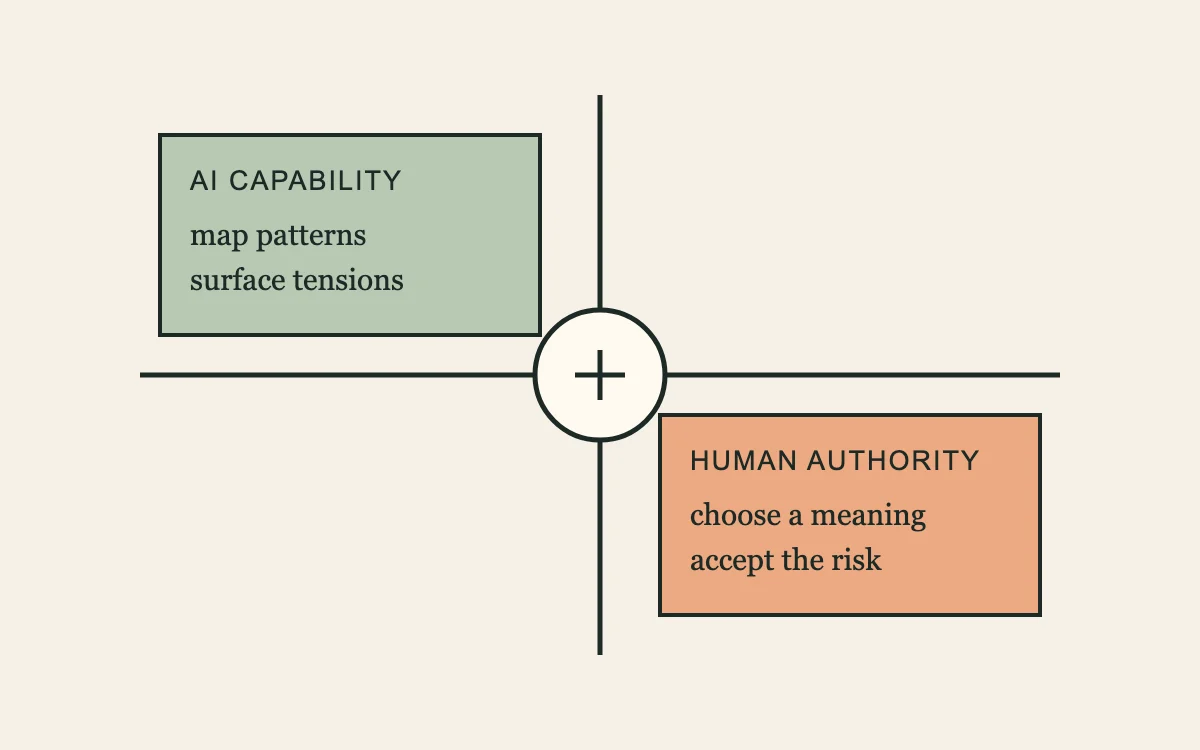
AI can help a strategy team see more of the room. It can sort a category’s claims, surface repeated language, map competitors, gather contradictions, and generate territories the team might not have named on its own. None of that means it should decide what the brand is willing to mean.
The distinction is simple but regularly blurred: capability is what a system can help analyse. Authority is who is accountable for the choice. A brand strategy fails when those are treated as the same thing.
The temptation is understandable. A model can produce a polished positioning statement in seconds, complete with audience, tension, promise, proof points, and a campaign line. Its fluency makes the decision look finished. But the central strategic choice is not a formatting problem. It is a commitment about credibility, trade-offs, and risk.
Use AI for breadth, not for the final claim
Give AI the work where breadth and comparison make a team sharper.
Evidence synthesis. It can inventory a bounded source set, group recurring claims, and help preserve source IDs. This is useful when the alternative is losing distinctions in a pile of research. It is not a substitute for deciding which source deserves trust. Start with a traceable brand-research workflow rather than asking for a market verdict from an unbounded prompt.
Competitor mapping. It can show which benefits, visual cues, and category phrases appear repeatedly. This can reveal a crowded centre. It cannot establish that a brand has permission to occupy the opposite edge.
Pattern detection. It can expose repetition and inconsistency across reviews, interviews, product pages, or campaign material. The pattern is an input to judgment, not judgment itself. A repeated complaint may represent a real problem, a vocal subgroup, or an artifact of the sample.
Territory generation. It can propose routes to discuss, combine, and reject. The value is divergence: a way to give a strategy team something specific to challenge. Treat the options as hypotheses, not a menu from which a brand identity can be selected.
Contradiction finding. This may be its most underrated use. Ask it to find the evidence that a confident narrative leaves out. A system that must label contradictory inputs is more useful than one rewarded for smoothing everything into a coherent paragraph.
Scenario exploration. It can help a team articulate what would change if an audience, product decision, or category move changes. Scenarios are rehearsals, not forecasts.
Keep authority where the consequence lives
The following choices should remain with accountable people, even when AI has helped assemble the evidence.
What tension is worth owning
Strategy is not the act of finding a tension. It is deciding which tension a company can credibly live with. “Convenience versus care” may be a rich territory for one brand and a hollow gesture for another whose operating model contradicts it. A model can name the phrase; leaders have to decide whether it is true enough to build around.
What cultural territory is credible
Culture is not a reference library. It includes relationships, history, permission, and the practical question of who will recognise the work as earned. AI can help identify codes and associations, but it cannot be accountable for borrowing them badly. The review should include people with relevant lived, market, and craft knowledge—not merely a request for a safer version of the same reference.
What the organisation actually believes
A brand has to be able to enact its claim across product, customer experience, hiring, pricing, and behaviour. No model can settle whether leadership will make the trade-offs a promise requires. If the internal answer is uncertain, that is a strategic finding, not a prompt defect.
What risk is acceptable
Every distinctive position excludes something: an audience, a familiar category signal, a short-term opportunity, or a safe consensus. Choosing that risk belongs to the people who own the outcome. NIST’s AI Risk Management Framework describes governance as cross-cutting and calls for documented roles, responsibilities, and risk management. The framework applies broadly to AI systems rather than brand strategy specifically. The editorial application is clear: do not let a system’s recommendation obscure the person who accepts the risk.
What should be distinctive—and what should be rejected
Models are excellent at plausible continuity. Strategy sometimes requires a discontinuity: a choice that looks strange before it becomes recognisable. That choice cannot be inferred from average category language. It needs a point of view and an owner prepared to defend it.
A capability-versus-authority workshop
Put two columns on the wall. In the first, list the questions AI may help answer: What did the evidence say? Which category claims recur? Where do sources disagree? Which assumptions have we not tested? What territories could we explore?
In the second, list the questions the team must answer: Which tension do we own? What are we willing to stop saying? Which audience do we prioritise? What risk can we accept? Which proof must be true before we make the claim?
Then force every proposed output into one column. A territory statement belongs in the first column only until a named human decision maker has selected, amended, or rejected it. This small procedural change is valuable because it prevents generated language from silently becoming strategy.
Record the handoff. Save the source boundary, the options considered, the objection that mattered, the decision owner, and the condition that would cause a revision. A strategic brief template is useful precisely because it turns a strategy from a polished statement into a record of choices.
The false choice between anti-AI and automatic AI
There is no virtue in refusing useful analysis because it came from a model. There is also no rigour in letting a system’s output decide the question it was asked to explore. The useful position is more demanding: use AI to widen the field, make assumptions legible, and sharpen the argument; reserve authority for the people who must make the promise real.
This is also where transparency becomes strategic rather than merely procedural. The World Federation of Advertisers reported in 2026 that surveyed brands widely viewed transparency around AI-generated marketing creative as important to reputation and trust. The WFA’s report describes a survey and voluntary guidance, not a universal consumer rule. It is nonetheless a reminder that the way a brand uses systems can become part of what the brand means.
Limits
This framework does not imply that every brand decision needs a committee, or that human judgment is automatically thoughtful. People can reproduce convention, ignore evidence, and avoid responsibility too. The point is accountability: a decision should remain challengeable by someone who can explain the evidence, accept the consequence, and change course when the claim no longer holds.
Practical resources
Evidence ledger
Sources
- 01AI Risk Management Framework Core
- 02AI Risk Management and Human-AI Interaction
- 03Global brands call for clearer consensus on AI labelling as usage accelerates
Links are descriptive and separated from editorial conclusions. Product behavior may change after the review date.
Next methods
Continue the work
guide · methods
How to Review AI-Generated Creative Work Without Losing Your Taste
An eight-lens creative review framework for choosing, editing, and rejecting generated work.
guide · tools
How to Use Claude for Brand Research
A staged evidence-led workflow for researching a brand with Claude while keeping claims traceable.
guide · methods
When to Use an AI Agent Instead of a Chatbot
A practical decision framework for choosing chat, a fixed workflow, or a bounded AI agent.