
When to Use an AI Agent Instead of a Chatbot
A practical decision framework for choosing chat, a fixed workflow, or a bounded AI agent.
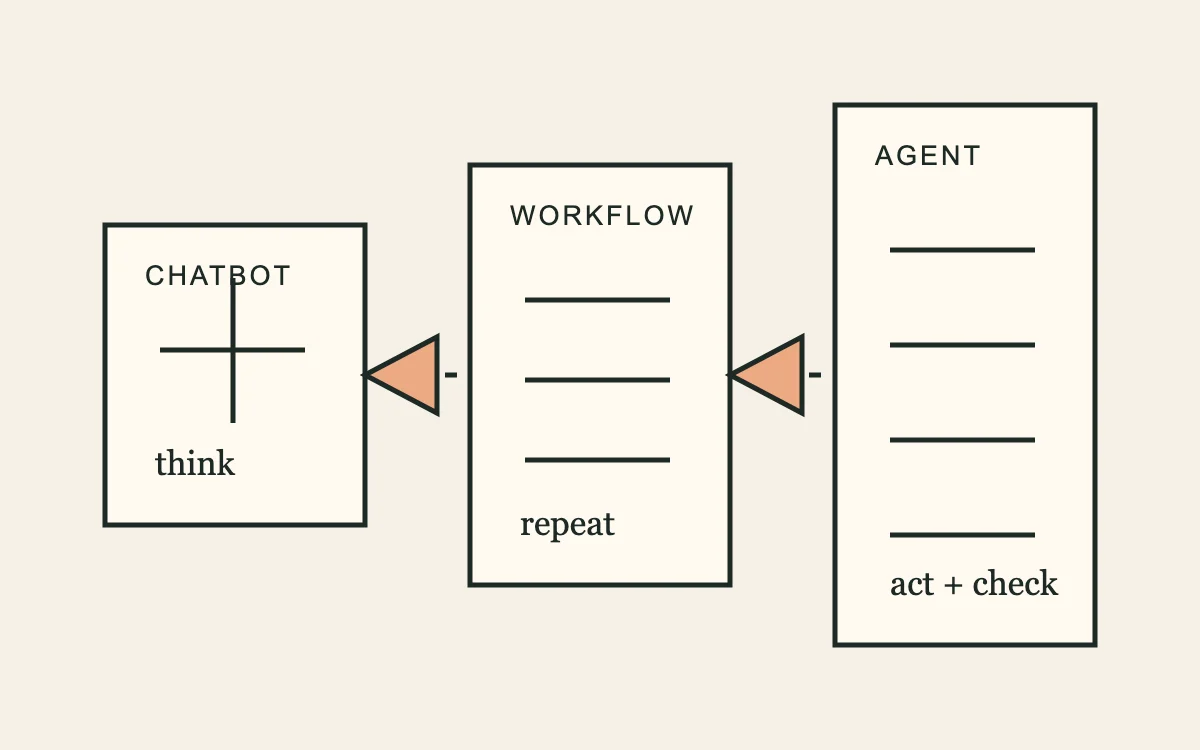
Most tasks described as “agent work” are not agent work. They are a question, a draft, or a small transformation wearing an expensive label. Giving those tasks tools, memory, and permission to keep going does not make them more useful. It makes them slower to inspect.
The practical choice is not chatbot versus agent. There is a middle form: the fixed workflow. Use a chatbot when the value is in the conversation. Use a workflow when the steps are known. Use an agent when the path has to respond to what it finds—and when you can define the boundaries of that response.
Decision rule: add autonomy only when the task needs it, and add verification before you add permission.
Start with the job, not the interface
A chatbot is good at thinking alongside you. Ask it to explain a concept, generate alternatives, turn notes into an outline, or make a one-step transformation. The answer is visible immediately. You can correct the premise, change direction, or ignore it. The unit of work is a conversation, and the human remains the router.
A workflow is different. Its stages are predictable: inventory the supplied material, pull out claims, check those claims, then format a brief. A model can participate at one or more stages, but the sequence and gates are set in advance. This makes a workflow easy to test because the same inputs should pass through the same checkpoints.
An agent earns its extra complexity when it must inspect an environment, select a next step, use tools, retain relevant state, and recover from a result that changes the plan. The useful version is not “an AI that does everything.” It is a bounded operator with a concrete job, a short tool list, stopping conditions, and a person who owns consequential decisions. Anthropic makes a related distinction between predefined workflows and systems that direct their own process and tool use; its guidance is to begin with the simplest workable architecture. Anthropic’s agent guide is useful here, but it is vendor guidance—not proof that a particular architecture will work for your task.
Use the seven-part decision map
Run a task through these questions in order. The first “no” is usually a reason to stay simpler.
1. Does the task need state?
State is information that must persist across steps: which sources have been checked, which customer record was updated, which files changed, or which exception is still unresolved. A chat can hold temporary context, but it is a poor system of record. If state is valuable yet the path is fixed, use a workflow with an explicit ledger. If the system must choose what to retain and retrieve as it goes, an agent may fit.
2. Does it need tools—and can the tools be safely bounded?
Reading a local folder, querying a database, creating a ticket, or running a test creates a different class of work than drafting an email. Give access only to the tools required for the job, with clear descriptions and constrained inputs. The OpenAI guide describes agents as loops that can call tools until a defined exit condition; that loop is precisely why tool scope matters. OpenAI’s practical guide should be read as implementation advice, not a permission slip for broad system access.
3. Is the route known in advance?
If you can draw the sequence on a whiteboard before you start, prefer a workflow. “Extract → compare → flag disagreement → produce a table” does not need an autonomous planner. A workflow is cheaper to maintain and easier to audit. An agent is useful when the number, ordering, or kind of steps depends on evidence discovered mid-task: researching a question whose sources reveal new questions, for example, or reviewing feedback that points to different follow-up tasks.
4. Can it verify progress against the world?
Good agent work gets ground truth after each meaningful action: a test result, a retrieved record, a successful write, a source opened, or a human confirmation. A fluent progress report is not ground truth. If the task has no reliable way to check intermediate progress, keep it conversational or place a human checkpoint before the result becomes consequential. Multi-step systems need trace-aware evaluation; Anthropic’s evaluation guidance emphasizes that final output alone can miss failures inside the run.
5. Are actions reversible?
The best early agent tasks have low blast radius. Creating a draft, proposing a change, opening a research queue, or editing a draft document can be reviewed or rolled back. Sending customer messages, publishing claims, changing prices, deleting records, or accepting legal terms require a much tighter permission model—often a human approval at the point of action.
6. What is the cost of a wrong iteration?
Agents can compound mistakes: a bad inference can select the wrong tool, which changes the state that shapes the next inference. Cost is not only token spend. It includes cleanup, reputational damage, missed exceptions, and the attention transferred to the reviewer. Estimate the repair cost before celebrating the first successful run.
7. Where is the accountable checkpoint?
Name the decision a person must still make. “Human in the loop” is too vague. A useful checkpoint says: the strategy lead approves the selected territory; the engineer approves a production write; the researcher confirms that a source supports the claim. If nobody can name that moment, the agent has probably been given authority rather than assistance.
Three decisions, three right-sized systems
Explain why a campaign brief feels generic. Use a chatbot. The work is interpretive and benefits from an active exchange. Ask for observations, counterexamples, and edits; do not grant tools because there is nothing to inspect or change.
Turn a weekly set of interview notes into a consistent evidence table. Use a workflow. Define source IDs, fields, a contradiction check, and the output format. The process is repeatable, and each stage can be reviewed without asking the model to invent a plan.
Check a research brief against a bounded source folder. Consider an agent. It may need to inspect the brief, open the cited sources, find a contradiction, revise a draft claim, and stop when a source is missing or a person must make a judgment. Its authority should exclude sending, publishing, or deleting anything unless a person explicitly approves it.
The common false upgrade
Teams often add an agent because a prompt produces inconsistent work. That may be a context problem, an evaluation problem, or a missing workflow—not a need for autonomy. Start by defining the input packet and the definition of done. A structured operating brief keeps evidence, constraints, and decisions separate. Then add a fixed gate. Only after those controls prove insufficient should the system choose its own next tool call.
This matters culturally as much as technically. A chatbot makes its uncertainty visible in a conversation. An agent can hide uncertainty behind activity. The more it does, the easier it is to confuse motion with progress.
A short operating checklist
Before commissioning an agent, write down:
- the decision or artifact it is allowed to support;
- the state it may read and write;
- its approved tools and prohibited actions;
- the signals that count as verification;
- the maximum steps, spend, and elapsed time;
- the exact reason to stop or escalate; and
- the named human checkpoint.
If those fields make the task sound over-engineered, use chat. If they make the job clearer, you may have found a suitable workflow. If they reveal a changing environment, bounded tools, testable progress, and a recoverable action space, an agent can earn its place.
Limits
This is a decision framework, not a benchmark or a claim that one vendor’s agent implementation is more reliable than another. Model capability, tool permissions, data handling, and evaluation quality change by product, configuration, and date. For fact-bearing work, pair the system with the AI Source Verification Checklist. The point is not to automate more. It is to make the next action proportionate to the risk.
Practical resources
Evidence ledger
Sources
- 01Building Effective AI Agents
- 02A practical guide to building agents
- 03Demystifying evals for AI agents
Links are descriptive and separated from editorial conclusions. Product behavior may change after the review date.
Next methods
Continue the work
workflow · methods
How to Brief an AI Agent Like a Team Member
A reusable operating brief for AI agents: objective, context, tools, authority, evidence, checkpoints, and done condition.
guide · tools
How to Use Claude for Brand Research
A staged evidence-led workflow for researching a brand with Claude while keeping claims traceable.
workflow · methods
A Reliable AI Workflow for Turning Messy Research into a Clear Brief
A traceable evidence-to-decision pipeline with explicit contradiction and uncertainty passes.