
How to Brief an AI Agent Like a Team Member
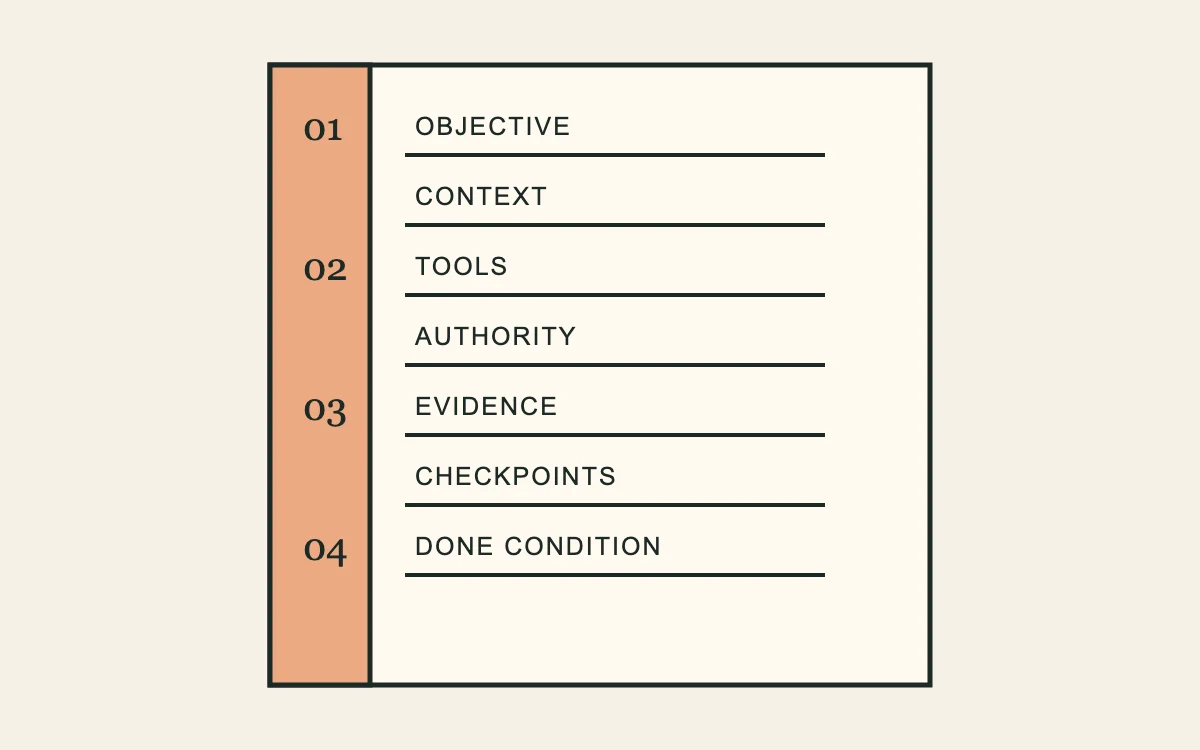
A reusable operating brief for AI agents: objective, context, tools, authority, evidence, checkpoints, and done condition.
“Research our competitors and tell me what we should do” is not a brief. It is a wish with a hidden budget, an undefined evidence standard, and no obvious moment to stop.
That kind of instruction can be acceptable in chat, where a person is present to clarify every turn. It is not enough for an agent that may inspect sources, make tool choices, preserve state, and produce an artifact someone else will rely on. As soon as work moves beyond one response, instructions start to resemble an operating brief.
The difference matters because a detailed prompt can still leave the important questions unanswered: Who owns the decision? What is the source boundary? Which tools are allowed? What should happen when evidence conflicts? What counts as done?
Prompt, brief, workflow specification
A prompt asks for a response: “Turn these notes into three headline options.” It is compact, local, and easy to revise.
A brief establishes the job: objective, audience, inputs, constraints, quality bar, and expected artifact. It tells a capable colleague why the work exists.
A workflow specification adds operational rules: approved tools, authority, checkpoints, state, failure handling, and stopping conditions. It tells an agent what it may do while no one is watching every step.
Do not turn every prompt into a specification. The test is simple: if the task can be completed in one visible response with no external action, use a prompt. If the task has a fixed sequence, use a workflow. If the system must select tools and adapt to what it discovers, write the operating brief below.
The ten fields of an operating brief
1. Objective
State the decision or deliverable, not an activity. “Produce a decision-ready competitor map for the positioning workshop” is better than “research competitors.” It identifies a use for the work and lets a reviewer recognise whether the output is relevant.
2. Context
Explain what is already known, what changed, the audience, and any definitions that matter. Context is not a file dump. It is the information the agent needs in order not to make a reasonable but wrong assumption. Anthropic’s context-engineering guidance describes agent context as a changing combination of instructions, tools, data, history, and state; its technical framing supports the practical point that the opening request is only one part of the system.
3. Inputs
List the approved materials and their authority. Give sources identifiers, dates, and limits. Say which document is a first-party claim, which is independent evidence, and which is a previous interpretation. Do not tell an agent to “use the web” when you actually need a constrained evidence set.
4. Constraints
Separate hard boundaries from preferences. A hard boundary might forbid confidential data, unapproved domains, personal data, or a public-facing action. A preference might request a concise table or a particular voice. When everything is described as important, the system has no way to recognise a real trade-off.
5. Tools
Name each allowed tool, its purpose, and any scope limit. “Search the approved source list; read only the project folder; run the targeted test command; create a draft file” is more useful than broad access. The agent guidance from both Anthropic and OpenAI treats tools as a core part of the design, not an afterthought. OpenAI’s guide is especially clear that a run needs conditions for completion; tool permission should be designed with those conditions.
6. Decision authority
This field should be uncomfortable. Write down what the agent may decide, what it may recommend, and what it must escalate. It may choose which approved sources to inspect next. It may not decide the final brand territory, publish an article, send a customer message, or alter a protected record. Authority is not a property of intelligence. It is a responsibility assigned by the organisation.
7. Evidence standard
Specify what a supported statement looks like. For example: every consequential claim needs a source ID and a direct supporting passage; conflicting sources must remain visible; product behaviour must be linked to current official documentation; conclusions based on incomplete material must be labelled as inference. This field turns “be accurate” into work someone can inspect. Use the AI Source Verification Checklist when a claim will leave the working document.
8. Checkpoints
Choose the moments a person needs to see: before an external write, after the source inventory, before a strategy recommendation, or when the system encounters a missing input. A checkpoint is not “ask questions if needed.” It names the condition and the reviewer. Anthropic’s practical agent guidance recommends human feedback at checkpoints and stopping conditions; the article’s framework applies that idea to editorial and strategy work rather than treating it as an engineering-only concern.
9. Output
Describe the artifact, its reader, required fields, and what not to include. “A one-page map with source IDs, competitor claims, contradictions, open questions, and no recommendation” prevents a model from producing a beautiful but unusable essay.
10. Done condition and failure rule
Finish with a testable end. A good condition says: all approved sources are inventoried; every selected claim has evidence or an uncertainty label; the table passes the stated schema; the strategy lead has approved the recommendation. A good failure rule says: stop if an approved source is unavailable, evidence conflicts on a consequential point, a required tool is missing, or a prohibited action would be needed.
A compact example
Imagine a strategy team preparing a workshop. The objective is not “find positioning.” It is “assemble an evidence map that lets the team decide which two tensions deserve a workshop.” Inputs are six named company and competitor sources. The agent may search those sources, extract stated claims, identify contradictions, and produce a table. It may not infer customer perception from company copy, browse beyond the source boundary, choose the final tension, or contact anyone.
The checkpoint comes after inventory: the strategist checks whether the source set is adequate. The evidence standard requires a source ID beside every factual statement. The done condition is a table that distinguishes company claims, independent evidence, editor interpretation, and open questions. If it finds a contradiction it cannot resolve, it marks it and stops rather than smoothing it into a theme.
That brief gives the system enough room to work and enough structure to fail safely. It is also useful to a human colleague. That is a good test: a strong agent brief should improve the team’s own handoff.
The failure patterns to remove
Unlimited authority. “Handle this end to end” moves accountability into an invisible place. Replace it with a precise action boundary.
Context as volume. A long upload without source roles or a decision goal does not become a brief. Add a source map and a context packet.
A quality bar with no evidence. “Make it insightful” is a taste preference masquerading as a check. Define examples, criteria, and a reviewer.
No exit. An agent that can keep researching, revising, or trying tools forever is not thorough; it is unbounded. Set time, step, cost, and escalation limits.
Limits
An operating brief cannot compensate for unsafe tools, weak source material, or an owner who will not make the decision. It also does not make the agent an employee: it has no independent accountability, context outside the systems you provide, or authority beyond what you configure. The gain is more modest and more valuable: a delegation that can be reviewed before its consequences become expensive.
Practical resources
Evidence ledger
Sources
- 01Building Effective AI Agents
- 02A practical guide to building agents
- 03Effective context engineering for AI agents
Links are descriptive and separated from editorial conclusions. Product behavior may change after the review date.
Next methods
Continue the work
guide · methods
When to Use an AI Agent Instead of a Chatbot
A practical decision framework for choosing chat, a fixed workflow, or a bounded AI agent.
analysis · methods
From Prompting to Orchestration: How Serious AI Work Is Changing
Why durable AI practice is moving from isolated prompt phrasing toward context, workflows, evaluation, and accountable orchestration.
workflow · methods
A Reliable AI Workflow for Turning Messy Research into a Clear Brief
A traceable evidence-to-decision pipeline with explicit contradiction and uncertainty passes.