
From Prompting to Orchestration: How Serious AI Work Is Changing
Why durable AI practice is moving from isolated prompt phrasing toward context, workflows, evaluation, and accountable orchestration.
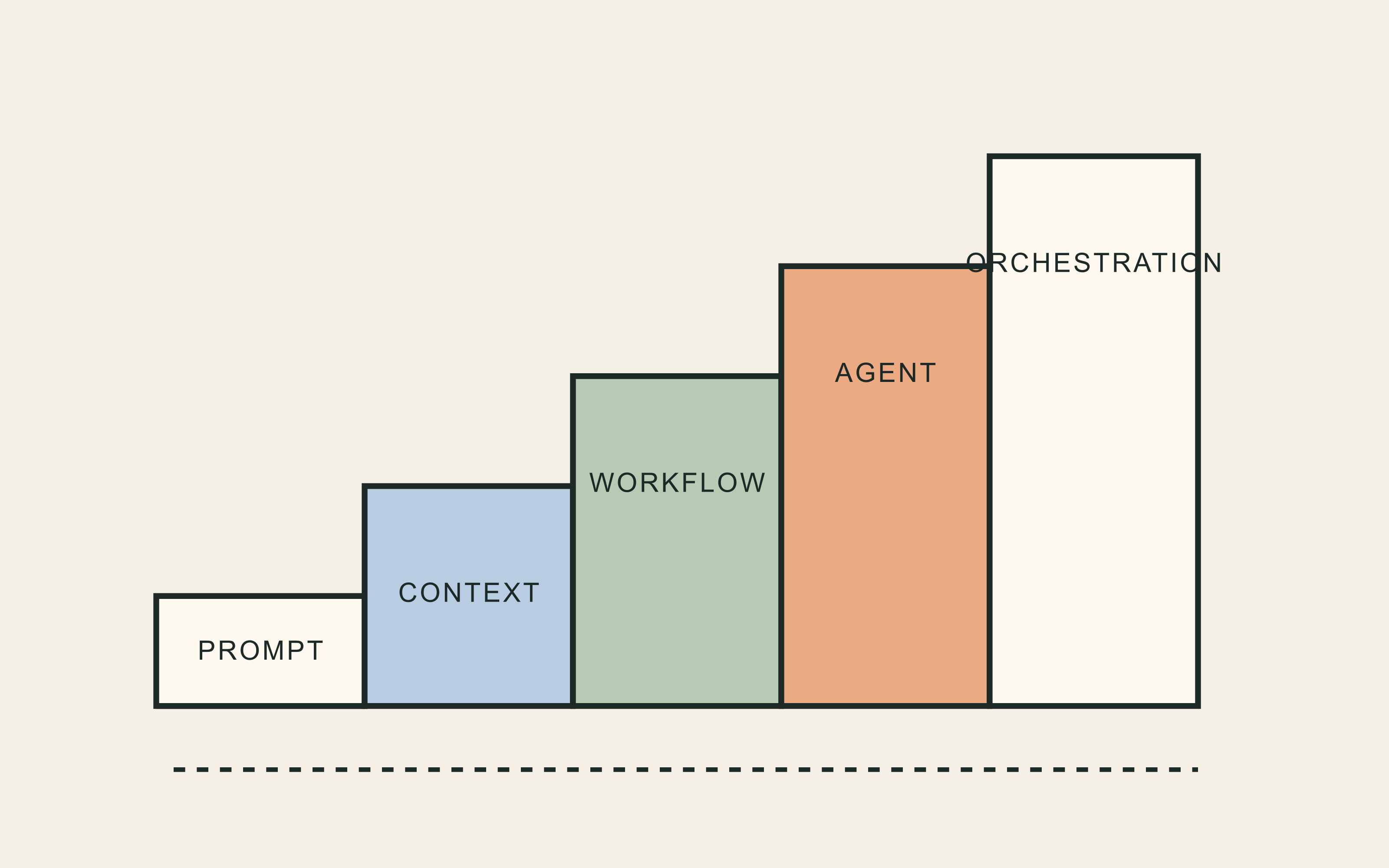
For a while, the unit of AI work was the sentence you typed into a box. This made sense. The early challenge was getting a useful response from a general model, and a good instruction could materially change the result.
The unit is getting larger. Serious work increasingly depends on what happens around the prompt: which facts enter the context, which tools can be used, what persists between steps, how an output is checked, when a person intervenes, and who owns the final choice.
That does not mean prompting is dead. It means prompting has found its proper place: one component in a designed working system.
Prompt: the right tool for a local transformation
A prompt remains the best form when the task is immediate, visible, and reversible. Explain a concept. Turn notes into questions. Generate alternatives. Rewrite a paragraph for a different audience. The person asking can see the response, correct it, and decide whether it is useful.
The craft here is still real. Good prompts give a task, an audience, relevant constraints, examples when needed, and a clear response shape. But a better sentence does not solve a missing source boundary, an undefined decision owner, or a task that needs to operate across several systems.
Context: the material that makes a response relevant
Context is the information the system needs to act without guessing: source material, constraints, examples, prior decisions, definitions, and unresolved questions. It is not equivalent to a longer prompt or a larger upload.
Anthropic’s recent account of context engineering describes agent context as a dynamic set of system instructions, tools, external data, message history, and state. Its guidance is product-side engineering analysis, not a general law of knowledge work. Still, it captures the shift: as tasks become multi-turn, the relevant question becomes what the system has available at the moment it needs it.
Use context work when the output must stay faithful to a bounded set of evidence or decisions. A context packet can separate facts from examples, constraints from preferences, and open questions from conclusions. That separation makes later review possible.
Workflow: a repeatable sequence with visible gates
A workflow assigns a known order to a task. Inventory sources, extract claims, challenge contradictions, draft a brief, then run a review. The model may help at each stage, but the sequence is designed by the team.
Workflows matter because many apparent model failures are process failures. Asking for a strategy before the evidence has been inventoried creates premature synthesis. Asking for finished prose before a claim ledger exists makes fluent unsupported writing likely. A workflow creates places to catch those errors before they become expensive.
This is why the headline progression should not become a hierarchy of sophistication. A stable workflow is often preferable to an agent. Anthropic’s foundational agent guidance argues for simple, composable patterns and recommends increasing complexity only when needed. The guide distinguishes predefined workflows from agents that dynamically direct their own tool use. That is a useful design distinction, not a reason to name every sequence an agent.
Agent: a bounded loop that can inspect and adapt
An agent becomes relevant when the path cannot be entirely known in advance. It may need to review a folder of interview notes, find a claim that conflicts with another source, choose which source to inspect next, and return to a person with a precise question. The next step depends on what it finds.
The critical additions are tools, state, guardrails, exits, and verification. OpenAI’s practical guide describes agent systems in terms of tools, handoffs, guardrails, and runs that end when a final output or non-tool response is reached. That guide is implementation guidance for its ecosystem; the transferable lesson is that an agent without an exit condition is not a system design.
Use an agent only when the value of adaptive action exceeds the cost of controlling it. The decision framework for chatbots, workflows, and agents can help make that call.
Orchestration: designing the whole handoff system
Orchestration is not a grander name for multiple prompts. It is the design of how work moves among context, tools, models, evaluations, state, and people. It asks practical questions:
- What enters the system as authoritative context?
- Which task needs a fixed workflow and which needs an adaptive loop?
- What must persist across the run, and what should be discarded?
- Which tool can change the world, and which action requires approval?
- What evidence proves that the output is good enough?
- Where can a human disagree, redirect, or stop the work?
This is the durable layer because it survives product churn. Model names, interfaces, and features will change. A well-specified source boundary, review criterion, escalation rule, and decision log remain useful even when a team swaps tools.
Evaluation is the missing rung
The ladder is incomplete without evaluation. A prompt may be judged in the moment. A workflow can be checked at each gate. An agent needs both output quality and trace quality: did it use the right tools, respect permissions, preserve important uncertainty, and stop at the intended condition?
Anthropic’s 2026 evaluation guidance makes this point directly: multi-turn systems can fail in ways a final response conceals, so assessments need to consider the behaviour across the run. Its evaluation article reports the company’s experience rather than a universal methodology. The editorial conclusion is narrower: if you cannot say what good behaviour looks like, you are not ready to orchestrate it.
Human judgment is not the final rubber stamp
The human role should not be “approve whatever the system made.” In a good design, people set the objective, decide the risk tolerance, judge the consequential trade-offs, and participate at checkpoints where their context matters. AI can make analysis broader and iteration faster. It cannot take responsibility for what a brand promises, what a team publishes, or which uncertainty deserves more investigation.
This is why the most valuable AI practitioners may look less like prompt collectors and more like editors, producers, and systems designers. They know when a sentence needs a better instruction, when a process needs a gate, when a tool needs less permission, and when the work needs a person rather than another loop.
Choose the smallest useful level
Use a prompt for one visible transformation. Use context when relevance depends on structured input. Use a workflow when the steps are known and repeatable. Use an agent when the system must adapt through bounded tools and verifiable feedback. Use orchestration when several of these components must work together across a consequential process.
None replaces the previous level. A mature system contains many prompts; a good agent may execute a fixed workflow; an orchestration may decide that a human conversation is the correct next action. The aim is not maximal autonomy. It is reliable work with judgment still attached.
Limits
This is a conceptual map, not a forecast that every organisation will adopt the same architecture or that prompt skill has become irrelevant. The cited sources are official vendor material and should be read with that limitation in mind. Product capabilities and recommended patterns change quickly. Keep the system simple enough to inspect, and keep the decision close to the person who has to live with it.
Practical resources
Evidence ledger
Sources
- 01Effective context engineering for AI agents
- 02Building Effective AI Agents
- 03A practical guide to building agents
- 04Demystifying evals for AI agents
Links are descriptive and separated from editorial conclusions. Product behavior may change after the review date.
Next methods
Continue the work
guide · methods
When to Use an AI Agent Instead of a Chatbot
A practical decision framework for choosing chat, a fixed workflow, or a bounded AI agent.
workflow · methods
How to Brief an AI Agent Like a Team Member
A reusable operating brief for AI agents: objective, context, tools, authority, evidence, checkpoints, and done condition.
workflow · methods
A Reliable AI Workflow for Turning Messy Research into a Clear Brief
A traceable evidence-to-decision pipeline with explicit contradiction and uncertainty passes.