
How to Brief an AI Video Agent Like a Creative Director
A ten-part creative-direction brief that keeps an AI video task tied to an idea, visual world, constraints, and human approval.
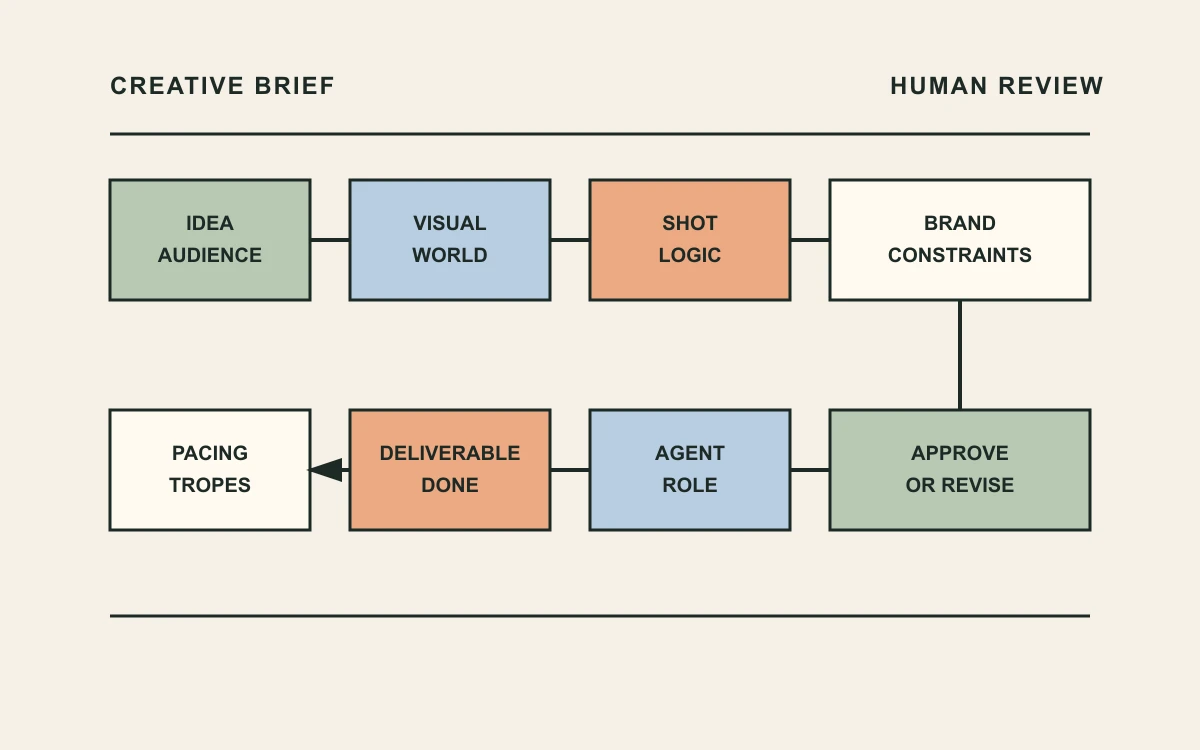
An AI video request becomes generic when it is written as a shopping list: cinematic, premium, emotional, fast-paced. Those are surfaces, not direction. A creative brief has to decide what the film is trying to make the audience notice, what visual logic carries that idea, and who has permission to change it.
The broader creative-work review method supplies the source, refusal, and selection questions that should inform this brief.
This is a framework, not a report on an agent test. The planned InVideo session may later add dated observations, but the brief should stand before a tool earns its way into the argument.
The brief has ten jobs
- Brand context: state the audience’s current relationship to the brand and the evidence that matters.
- Objective: name the change in attention, understanding, or action—not a vague desire for awareness.
- Audience: describe the viewer’s situation, knowledge, and resistance.
- Core idea / tension: write the contradiction the film must make felt.
- Visual world: specify material, place, light, scale, and what the image should avoid becoming.
- Pacing: describe where to linger, accelerate, interrupt, or leave space.
- Shot logic: say what each shot must prove, reveal, or withhold. A list of pretty shots is not a sequence.
- Brand constraints: identify claims, marks, language, rights, and approvals that cannot be improvised.
- Forbidden tropes: reject the familiar moves that would flatten the premise.
- Deliverable and done condition: name the format, duration, reviewer, and the conditions for a usable first cut.
Give the agent a production role, not authorship
The useful instruction is narrow: assemble a first cut that follows the supplied sequence; flag missing assets, conflicting instructions, and choices that need approval. The system can propose alternatives and expose ambiguity. It should not decide the brand promise, a cultural reference, the final pacing, or whether an idea belongs to the client.
That division is practical. It keeps feedback from turning into “make it better,” which is a request for the tool to infer a standard that nobody has written down.
A copyable brief skeleton
BRAND CONTEXT:
OBJECTIVE:
AUDIENCE:
CORE IDEA / TENSION:
VISUAL WORLD:
PACING:
SHOT LOGIC:
BRAND CONSTRAINTS:
FORBIDDEN TROPES:
DELIVERABLE:
DONE CONDITION:
HUMAN APPROVAL OWNER:
A bounded example
For a fictional neighbourhood repair cooperative, the tension is not “technology meets community.” It is: repair is slower than replacement, and that slowness creates knowledge people can share. The visual world is workbenches, labelled parts, hands pausing to inspect; the forbidden trope is a frictionless transformation montage. The done condition is a 30-second cut in which every shot either shows diagnosis, repair, or the transfer of know-how.
This example demonstrates how a brief makes choices inspectable. It does not show that an AI video agent can execute the brief faithfully.
Review the first cut against the brief
Do not begin by asking whether the output looks expensive. Ask whether the tension survived, whether the sequence has a point of view, and whether any constraint was silently replaced by a familiar visual convention. Record each revision as a request tied to a field above. If a revision changes the idea rather than its execution, stop and ask the human approval owner.
This framework has not been verified with an InVideo session. Before trusting any first cut, compare its actual shots with the brief, record what changed, and keep the final creative decision with a person.
Practical resources
Evidence ledger
Sources
Links are descriptive and separated from editorial conclusions. Product behavior may change after the review date.
Next methods
Continue the work
workflow · methods
How to Brief an AI Agent Like a Team Member
A reusable operating brief for AI agents: objective, context, tools, authority, evidence, checkpoints, and done condition.
workflow · methods
How to Give AI Brand Guardrails That Hold Up
Move beyond tone adjectives with a five-part brand guardrail system that makes AI-assisted work easier to review and harder to make generic.