
How to Use AI Without Producing Generic Creative Work
A divergence-and-critique framework that protects a specific point of view.
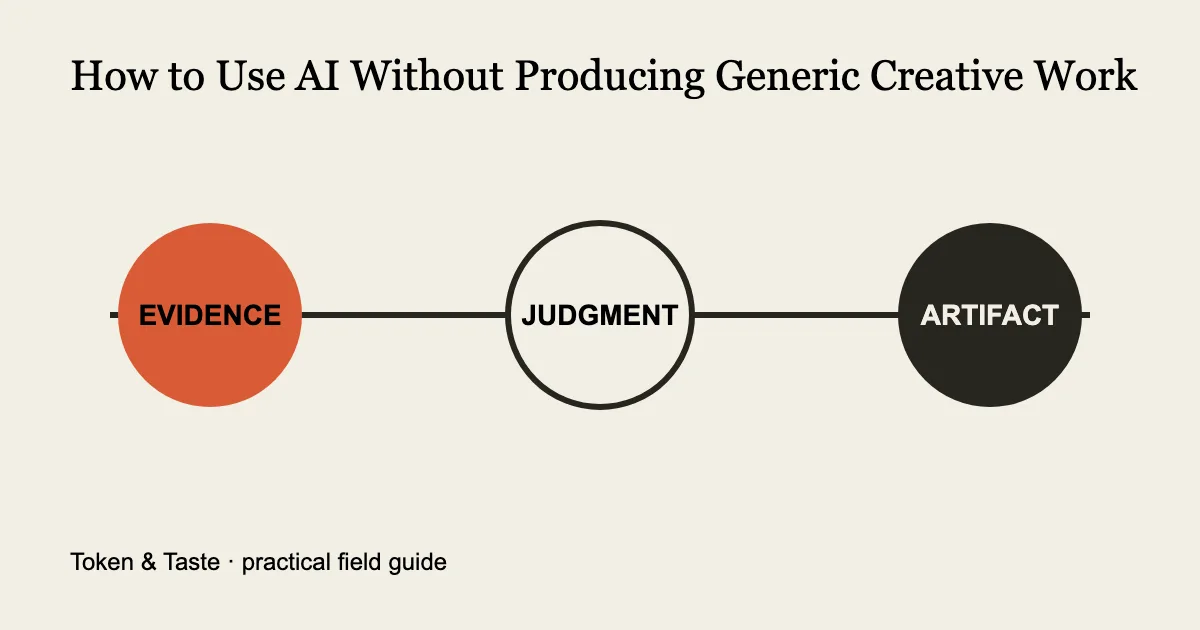
Generic creative output usually begins before the tool is involved. If the brief contains familiar category language, no source texture, and no meaningful constraint, a model can only produce fluent variations of the average.
Distinctive work comes from better inputs and harder selection—not a magic prompt. Use AI to expand and interrogate possibilities while keeping taste, authorship, and consequential choices with people.
Diagnose the generic brief
Underline words that could describe any competitor: seamless, innovative, empowering, premium, bold. Replace each with evidence, a specific behavior, or an unresolved decision. Define what the work must make the audience notice and what familiar convention it should refuse.
Prepare four inputs:
- Source material: real language, observations, product behavior, history, or constraints you are allowed to use.
- Point of view: three beliefs the work will defend.
- Reference set: examples annotated for the principle that matters—not surfaces to copy.
- Selection criteria: what “specific,” “credible,” and “useful” mean for this assignment.
Diverge by tension, not volume
“Give me 30 ideas” often produces one idea with different nouns. Define contrasting territories around genuine tensions: expert guidance versus self-direction, ceremony versus speed, familiarity versus productive friction. Ask for a small number of approaches that make different choices.
For each territory, require a premise, audience tension, evidence used, convention rejected, execution principle, and risk. This makes alternatives comparable without pretending creativity is a numeric leaderboard.
Use references as taste input
Annotate why each reference belongs: pacing, material honesty, argumentative structure, use of silence, or relationship between image and type. Also state what must not be copied. A mood board without annotations encourages surface mimicry.
Do not upload copyrighted work or confidential materials without permission. References inform judgment; they do not license imitation.
Select before polishing
Choose using the prewritten criteria. Ask:
- Which option makes a consequential choice?
- What source material can only belong to this project?
- Where does the idea become familiar or overly symmetrical?
- What would a skeptical audience reject?
- Can the organization sustain the promise in practice?
Discard attractive options that fail the premise. Combining every favorite element usually restores the generic compromise you were trying to escape.
Illustrative before and after
Before: “A bold platform empowering modern teams to unlock their potential.” The sentence names no audience problem, evidence, or choice.
Process: A fictional cooperative’s source packet shows that members share unfinished work every Friday and value useful critique over polished performance. The editor selects “practice in public” as the governing tension and rejects growth language.
After: “Bring the unfinished thing.” The line is not inherently better because it is shorter; it is better fitted to the supplied behavior and implies a specific invitation. This is an illustrative editorial example, not a tested campaign result.
Revise with distance
After choosing a territory, remove the strongest execution and rebuild from its principle. Change medium or scale. Ask a human unfamiliar with the process what feels inevitable, copied, vague, or unsupported. Use AI as a critic by assigning a narrow lens—category cliché, unsupported promise, or loss of source detail—then make the decision yourself.
Try, check, and keep
Try: Build three territories from one real tension. Limit each to a premise, one source detail, one refusal, and one risk.
Check: Hide the project name. Could the option belong unchanged to a competitor? Can every distinctive claim return to source material? Are references shaping principles rather than being imitated?
Keep: Use the creative work review checklist to record why the selected route survived and why the others did not.
Limits
A process cannot guarantee originality. Models may reproduce familiar patterns, and human reviewers bring their own biases and blind spots. Check trademarks, rights, cultural context, factual claims, and accessibility with appropriate specialists. Do not present generated material as observed audience response.
The aim is not novelty at any cost. It is work whose choices can be traced to a particular problem, source set, and point of view.
Practical resources
Evidence ledger
Sources
Links are descriptive and separated from editorial conclusions. Product behavior may change after the review date.
Next methods
Continue the work
guide · tools
How to Use Claude for Brand Research
A staged evidence-led workflow for researching a brand with Claude while keeping claims traceable.
comparison · tools
ChatGPT vs Claude for Strategic and Creative Work
A task-based selection framework that avoids declaring a universal model winner.