
What AI Gets Wrong About Brand Voice
Why brand voice is a strategic relationship, not a tone slider—and what a human must still authorize.
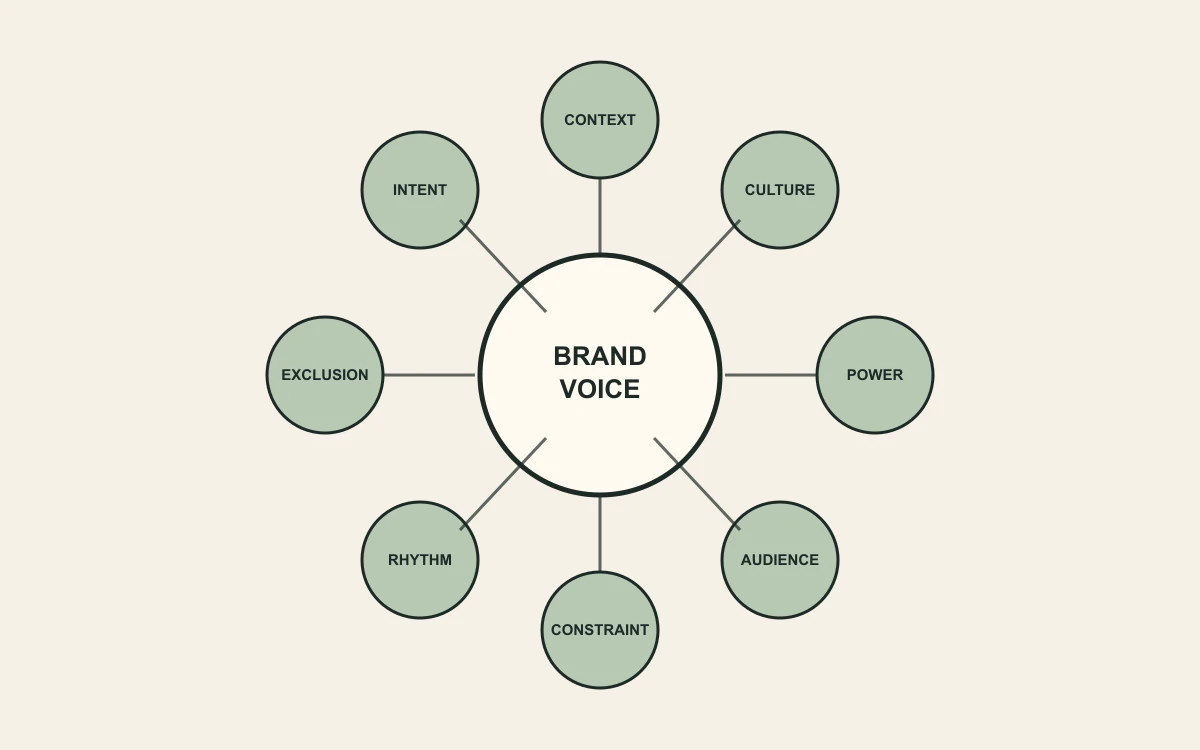
AI can imitate the visible residue of a brand voice: sentence length, a set of preferred verbs, a few familiar phrases. It cannot be accountable for the relationship those choices create with a particular audience. That is why output can be grammatically on-brand and strategically wrong.
Voice is not a tone setting. It is a set of choices made under context, history, and constraint.
Eight things a tone prompt leaves out
Context: the same sentence can reassure in a service recovery and patronise in a crisis. Cultural reference: a phrase can signal fluency to one group and extraction to another. Power: who gets to speak, define the problem, and make the promise changes the voice. Audience relationship: a member, a buyer, a patient, and a colleague are not interchangeable recipients.
Constraint: legal, factual, ethical, and operational limits shape what the brand may say. Rhythm: voice includes when to be plain, when to pause, and when not to fill silence. Exclusion: every voice refuses something—jargon, false intimacy, category optimism, borrowed subculture. Strategic intent: a brand can choose to clarify, challenge, invite, or decline; those are not merely stylistic moves.
What AI can propose
It can propose alternate phrasings, surface repeated language, compare a draft against approved examples, flag inconsistency, or ask where an instruction is underspecified. Those are useful contributions because they stay open to review.
What a human must authorize
A human must authorize the promise, the audience relationship, the cultural reference, the risk of exclusion, the strategic stance, and the final selection. The human also owns the question a polished draft can hide: is this true, appropriate, and ours to say?
That boundary is not anti-tool. It gives the tool a role it can perform without pretending that a generated line has earned consent or cultural intelligence.
A review question that catches the problem
Instead of asking “does this sound like us?”, ask: “What relationship is this sentence trying to create, and what evidence gives us the right to create it?” If the answer is a list of adjectives, the work is still too vague. If the answer names a real audience situation, a constraint, and a choice the organisation can stand behind, the voice has somewhere to live.
Use brand guardrails to make the boundary explicit, then use the creative review checklist to record the decision. This is an editorial argument, not a model test or a claim that any brand voice can be reduced to a framework.
Practical resources
Evidence ledger
Sources
Links are descriptive and separated from editorial conclusions. Product behavior may change after the review date.
Next methods
Continue the work
workflow · methods
How to Give AI Brand Guardrails That Hold Up
Move beyond tone adjectives with a five-part brand guardrail system that makes AI-assisted work easier to review and harder to make generic.
guide · methods
How to Use AI Without Producing Generic Creative Work
A divergence-and-critique framework that protects a specific point of view.