
From Research to Slides Without Letting AI Flatten the Argument
A five-stage workflow that preserves evidence, causality, and narrative before AI-assisted slide production.
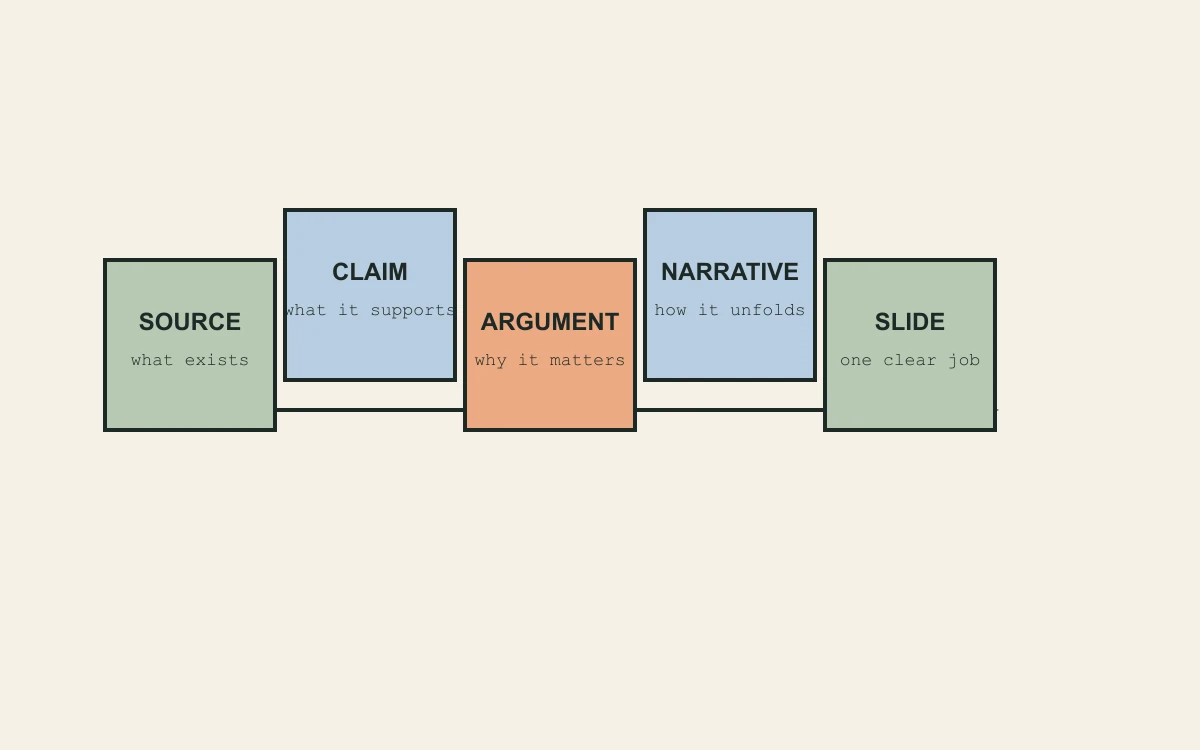
AI can turn a source packet into a plausible deck very quickly. The failure is not that the deck is ugly. It is that a source becomes a sentence, a sentence becomes a slide title, and the missing reasoning disappears between them.
Keep five objects separate: SOURCE → CLAIM → ARGUMENT → NARRATIVE → SLIDE. Each answers a different question and deserves a different review.
The five handoffs
Source: record the passage, date, author, scope, and limitation. Claim: state only what the source can support. Argument: explain why that claim matters to the decision and what alternative explanation remains. Narrative: order the claims so the audience can follow the change in stakes. Slide: give one visual or verbal job to one moment in the narrative.
AI can help inspect gaps at every stage. It should not turn an absent warrant into confident connective language.
A concrete transformation
Imagine an internal report says: “In interviews with twelve support leads, handoff delays were mentioned more often after an escalation than after a routine request.”
- Source: the dated interview memo; small sample, self-reported observations.
- Claim: escalation handoffs were a more frequent concern in this interview set than routine handoffs.
- Argument: improving routine response time alone may not address the delay the team is hearing about.
- Narrative: first show why the broad service-time story is incomplete; then focus attention on the escalation moment.
- Slide: “The reported delay is concentrated at escalation handoff.” Use a labelled excerpt count, the sample limitation, and a transition to the proposed review.
The source does not prove the whole service system is slow. The slide should not say it does. That restraint is the argument becoming more useful, not less persuasive.
Use AI as a skeptical assistant
At the claim stage, ask it to list unsupported modifiers and missing definitions. At the argument stage, ask for the strongest alternative explanation. At the narrative stage, ask it to identify the point where the audience has to make an inferential leap. At the slide stage, ask it to remove anything that does not serve the slide job.
Do not ask for “a compelling deck” while the source table is still unresolved. That instruction rewards rhetorical continuity over evidence discipline.
A short review pass
Before generating slides, check that every consequential headline can point back to a claim ID, every claim can point back to a source, and every source limitation survives the handoff where it matters. The presentation argument planner can keep those fields together.
This is a practical framework, not a report of an experiment. It does not claim that a particular model, prompt, or slide tool preserves arguments reliably. It gives a human reviewer the places where flattening usually begins.
Practical resources
Evidence ledger
Sources
Links are descriptive and separated from editorial conclusions. Product behavior may change after the review date.
Next methods
Continue the work
guide · methods
How to Build a Presentation with AI Without Losing the Argument
An argument-first sequence that separates evidence, narrative, and slide production.
workflow · methods
A Reliable AI Workflow for Turning Messy Research into a Clear Brief
A traceable evidence-to-decision pipeline with explicit contradiction and uncertainty passes.