
How to Build a Presentation with AI Without Losing the Argument
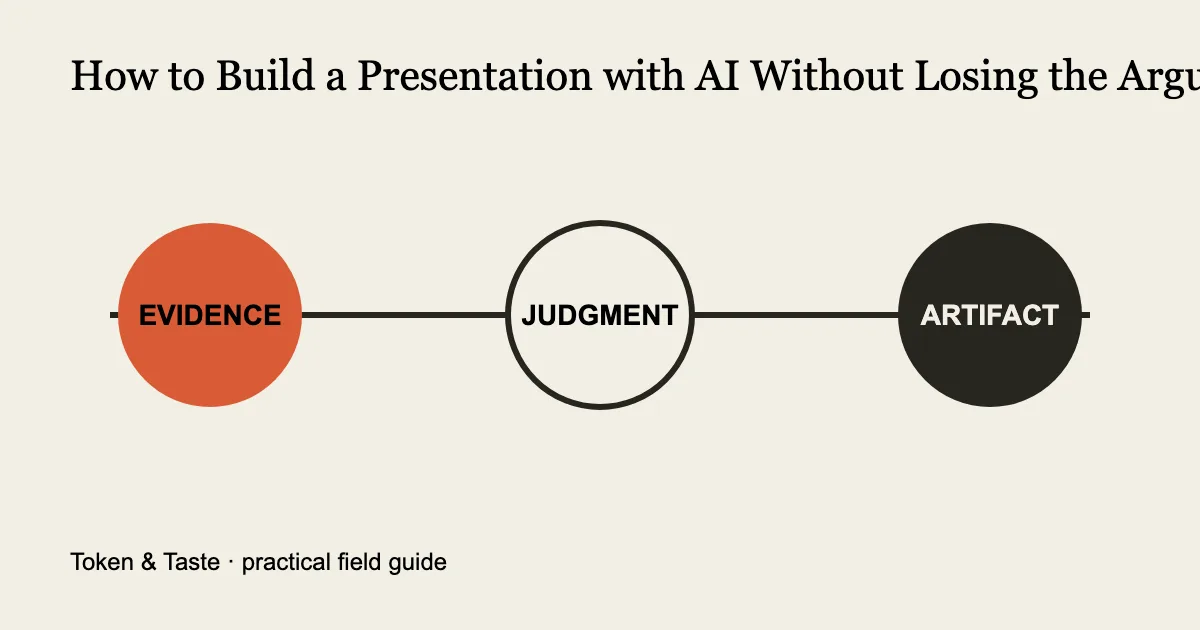
An argument-first sequence that separates evidence, narrative, and slide production.
A presentation can look finished while its argument is still missing. Generating slide titles too early encourages the team to decorate a sequence before deciding what the audience should understand, believe, or do.
Use AI after the reasoning is visible. The sequence is argument → evidence → structure → slides → visual support. Moving backward is allowed; skipping directly to slides is the failure to avoid.
Write the audience change
Before opening a tool, complete three sentences:
- The audience currently believes or does…
- After the presentation, they should understand…
- The decision or action we are asking for is…
If the requested change is vague, more slides will not fix it. Name the strongest reasonable objection too; it will shape the evidence you need.
Build an evidence table
Create one row per consequential claim. Include source, date, exact support, limitation, and the audience question it answers. Separate evidence from interpretation. A chart is not evidence by itself: its source, denominator, time period, and relevance must remain available to the reviewer.
Draft the argument as sentences
Write a short chain before slide titles:
- Situation the audience recognizes.
- Tension or problem that changes the stakes.
- Claim supported by the evidence.
- Alternatives considered.
- Recommendation and consequence.
Ask AI to challenge missing warrants or reorder the chain, not to invent support. Keep rejected structures; comparing them can reveal which assumption is doing too much work.
Convert one claim into one slide job
A slide job is a sentence such as “Show that delays concentrate at the handoff, not throughout production.” It is not “Operations overview.” From each job, derive a headline that states the point, the minimum evidence required, and the speaker’s transition.
Only then decide whether the best support is a chart, excerpt, diagram, table, or no visual at all. Decorative imagery should not compete with evidence. Every element must either advance the claim, provide orientation, or be removed.
Illustrative before and after
Before: “Market opportunity” followed by four uncited statistics and a generated illustration.
Process: The editor checks the sources, discovers that two figures describe different geographies, and narrows the claim to the one decision the available evidence supports.
After: “The reachable segment is smaller—and better matched to our channel” with one sourced comparison, a visible assumption, and a note explaining what would change the estimate.
This example demonstrates structural improvement; it is not a report of measured presentation performance.
A critique prompt
Review this argument map as a skeptical audience member. Do not write slides. For each claim, identify the evidence supplied, the missing warrant, the strongest alternative explanation, and the decision it supports. Mark unsupported claims rather than completing them. Return a table keyed to claim IDs.
Use the output as questions for the author. Do not accept an objection or correction without checking it against the source set.
Try, check, and save
Try: Take an existing deck and write the job of each slide in the margin. Remove slide language from the job statement.
Check: Can the audience action be stated in one sentence? Does every consequential headline have adequate support? Does the sequence answer the strongest objection before the recommendation?
Save: Use the presentation argument planner to keep audience change, claims, evidence, and slide jobs together.
Limits
AI cannot decide which evidence your organization is permitted to use, whether a recommendation is politically or ethically sound, or whether the presenter truly believes the argument. Generated charts and citations require direct verification. For high-stakes decisions, involve the relevant domain and accessibility reviewers.
The deck is ready for design when the argument can survive without design. Visual craft should sharpen reasoning, not disguise its absence.
Practical resources
Evidence ledger
Sources
Links are descriptive and separated from editorial conclusions. Product behavior may change after the review date.
Next methods
Continue the work
guide · tools
How to Use Claude for Brand Research
A staged evidence-led workflow for researching a brand with Claude while keeping claims traceable.
comparison · tools
ChatGPT vs Claude for Strategic and Creative Work
A task-based selection framework that avoids declaring a universal model winner.