
ChatGPT vs Claude for Strategic and Creative Work
A task-based selection framework that avoids declaring a universal model winner.
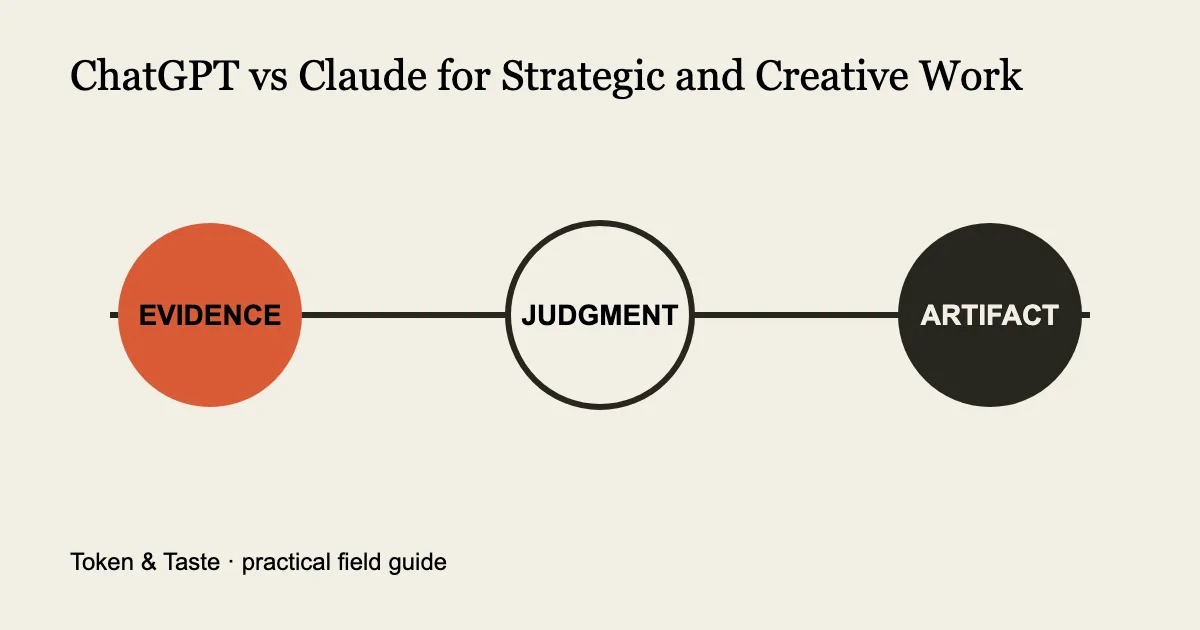
“Which tool is better?” is too broad to guide strategic or creative work. Tool choice depends on the stage of the task, the material being handled, the review burden, and the interface available to the reader.
This article offers a decision framework, not observed head-to-head results. We did not run a controlled comparison for this edition, so no winner, score, or performance claim is presented. The accompanying sheet is for readers to record their own tests.
Start with the job, not the brand name
Break the assignment into operations. A creative brief might require source ingestion, question generation, synthesis, divergent options, critique, rewriting, and final formatting. Compare tools on one operation at a time. Otherwise a polished final document can hide where evidence was lost.
Ask four questions:
- What material must the tool handle? Note length, file types, sensitivity, and whether the source set changes.
- What must remain traceable? A factual synthesis needs source IDs; early ideation may instead need range and useful provocation.
- What interaction helps? Consider the actual products available: project spaces, file handling, browsing, export, or collaboration—not an abstract model name.
- What can a person realistically review? Faster generation is not an advantage when it multiplies plausible but unusable options.
A fair comparison method
Use the same source packet, instructions, output format, and time allowance. Start fresh sessions and record the product, visible model label if available, date, and enabled tools. Preserve raw outputs. Do not quietly improve one prompt after seeing the other response.
Judge with a defined qualitative rubric:
- Strong: usable with minor editing; important claims remain traceable.
- Mixed: useful material exists, but omissions or repair work are substantial.
- Weak: the output obscures evidence, ignores constraints, or does not support the task.
Assess traceability, constraint following, useful divergence, contradiction handling, and repair effort separately. A single total score erases the reason for choosing a tool.
Example decision, not a test result
Suppose a strategist has twelve interview excerpts and needs two things: a claim ledger and three campaign territories. They could test both tools on the ledger first, then separately on divergence. If Tool A keeps source IDs intact but produces similar territories, while Tool B offers wider territories but loses provenance, the sensible workflow may use A for the evidence stage and B for a deliberately de-identified ideation packet. That is an illustrative decision pattern—not an observation about current ChatGPT or Claude behavior.
When to begin in either tool
Begin in the product that best supports the immediate operation with the least handling risk. Favor neither tool universally. Current capabilities, limits, and terms change; consult the first-party documentation linked in the source section and verify them in the account you actually use.
For sensitive material, tool choice follows organizational policy, contracts, and data-handling review. A convenient interface does not create permission to upload the source set.
Try, check, and keep
Try: Select one real, low-risk operation and prepare a fixed source packet plus acceptance criteria. Run it unchanged in both tools.
Check: Compare raw outputs before revising. Mark unsupported additions, missed constraints, collapsed disagreement, and substantive edits needed. Record “not tested” for capabilities you did not exercise.
Keep: Download the model comparison test sheet with the inputs and raw outputs. The record matters more than a universal verdict.
The decision rule
Choose at the level of the task stage, not personal allegiance. Repeat a small comparison when the material, risk, model, or interface changes. The useful question is: “Which setup makes this operation inspectable and reviewable for this team today?”
Practical resources
Evidence ledger
Sources
Links are descriptive and separated from editorial conclusions. Product behavior may change after the review date.
Next methods
Continue the work
guide · tools
How to Use Claude for Brand Research
A staged evidence-led workflow for researching a brand with Claude while keeping claims traceable.
guide · methods
How to Build a Presentation with AI Without Losing the Argument
An argument-first sequence that separates evidence, narrative, and slide production.