
Should You Make AI Ask Questions Before It Starts?
A three-condition assistant test separates the value of clarifying questions from the value of supplying missing facts.
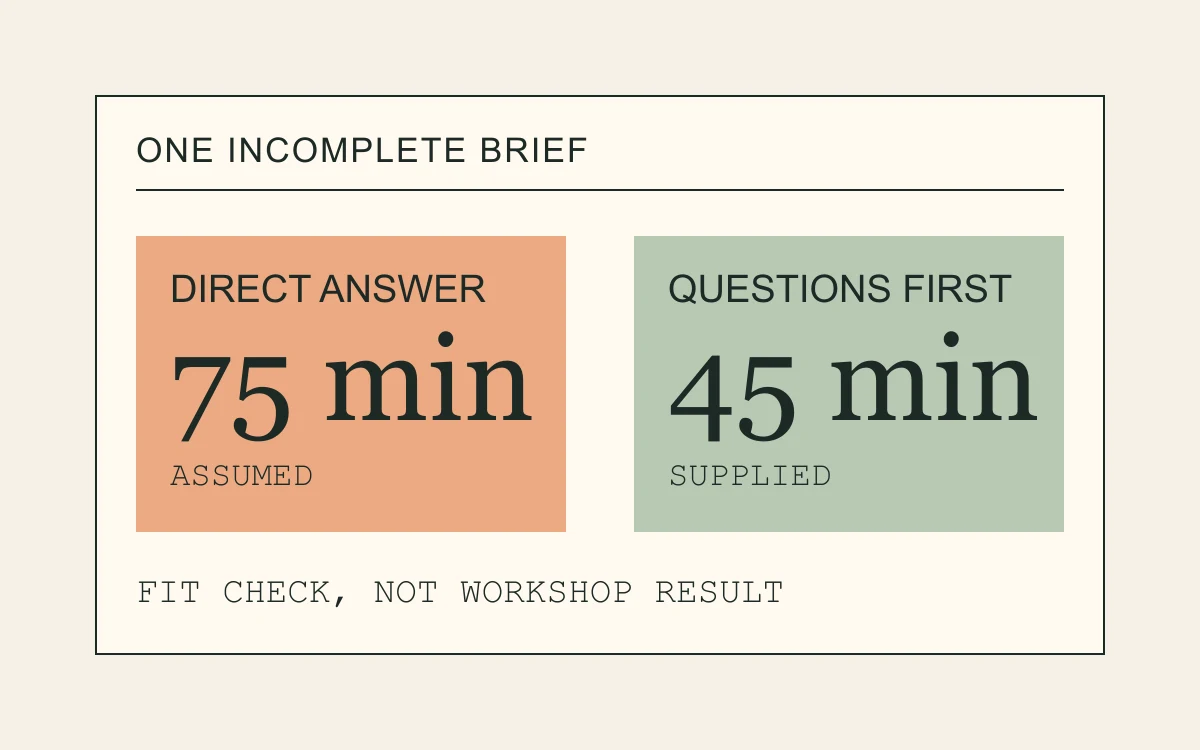
An incomplete brief invites an AI assistant to fill gaps. That can make a first answer look ready to use even when the assistant has chosen the time, audience, or scope for you. We tested three paths on one fictional community workshop brief: answer the incomplete request directly (A), ask five questions and then answer them (C), or receive the same useful facts up front and answer directly (D).
In this test, providing the missing facts mattered. Both C and D fitted the stated 45-minute session for eight adults. The question step helped surface facts when the brief was incomplete, but these outputs do not show an independent advantage over supplying those facts up front.
The task
The request was: “Plan a small community workshop about using AI to organize household paperwork. Provide a concise outline with activities and a take-home item.” The library, participants, and paperwork were fictional. No real attendee or document was involved.
Before the original runs, we wrote down the missing facts: eight adults with mixed digital confidence, a 45-minute library session, a projector but no required participant accounts, fictional bills and letters, no real private-document uploads, no legal or financial advice, and a paper checklist as the take-home item. We withheld those facts from A, supplied them after the questions for C, and gave the same useful facts at the start of D. The answer bank was frozen before A; D was added three days after A and C.
What changed between the three paths
| Path | Instruction | What the assistant received |
|---|---|---|
| A: direct, incomplete | Complete the outline immediately and state assumptions. | The short task only. |
| C: questions first | Ask five material questions, receive answers, then make the outline. | The short task, questions, and the frozen answer bank. |
| D: direct, equal information | Make the outline without asking questions. | The short task and the same useful answer-bank facts up front. |
Each output came from a fresh Codex CLI session using the same named model, gpt-5.6-sol. C depended on an earlier question-only run (B). C and D had the useful facts in different sequences; A did not have them. This is a small qualitative comparison, not a randomized evaluation. The evidence packet retains the inputs, outputs, and method.
What happened
The direct outline set a 75-minute session for 8–15 adults. Those details were not in the request. It also assumed participants would bring a phone or laptop and widened the task to folder structures and retention reminders. The response marked some of these as assumptions, which is better than hiding them, but the plan was still built around them.
The questions-first response asked who would attend, how long the session would be, which devices and tools were available, which paperwork tasks mattered, and what privacy or accessibility needs to consider. It did not explicitly ask what success should look like. We supplied the facts already prepared for the test, including the success criterion, and left internet availability and specific accessibility accommodations unanswered.
The resulting C outline fit 45 minutes for eight adults. It used fictional documents, included a paper checklist, asked people to verify dates and amounts against the originals, and made room for decisions the AI should not make. It still proposed a demonstration using prepared output without knowing exactly which tool or connection would be available. A human organizer would need to settle that before running a real workshop.
D also planned 45 minutes for eight adults, using fictional samples, an account-free demonstration, a paper checklist, and a fallback if the demonstration failed. Its added facts were enough to avoid A’s major unsupported assumptions without a question turn. D introduced an unsupplied “Discard” sorting category, though, which an organizer should review rather than treat as a fact from the brief. C and D were both useful drafts; we did not measure which would work better with real participants.
What surprised us
The direct A answer was plausible. Its risk was a confident plan for a workshop we had not actually specified. B’s questions were useful, but they missed a key question about success. C improved once the answers arrived; D reached similar factual fit with those answers already in the brief. This points to missing context as the clear lever in this case, while leaving open whether a question step has other benefits on other tasks.
Try it yourself
Copy this when an assistant is about to start from a brief with important gaps:
You can also copy the short prompt card.
I need [deliverable] for [audience or situation].
Before drafting, ask up to five questions whose answers would most change the result.
Prioritize audience, purpose, scope, hard constraints, and what success looks like.
Do not invent the missing answers. After I reply, draft the deliverable and mark what is still unknown.
If you cannot answer a question, write “unknown.” Review the result for new assumptions anyway. The question pass costs another exchange; use it when a wrong assumption would create meaningful rework.
If the task has several confirmed facts already, put them in a context worksheet first. Then ask the assistant only about gaps that could change the outcome. When the facts are complete enough, D suggests that a direct request can be just as useful for this type of task. Keep the completed worksheet beside the draft so you can check which details came from you and which came from the assistant.
What I would test next
I would repeat the A/C/D comparison across several briefs, randomize the order, and have independent readers judge the outputs without knowing the condition. I would also ask explicitly about success criteria, because B’s five questions did not.
Limits of this test
This was one synthetic task with one output per final path. It does not measure workshop effectiveness, participant experience, time saved, or how another assistant would behave. D was added after the A/C runs, so it improves interpretation without removing all order and run variability. A lacked facts that C and D received; the observed result supports a bounded conclusion about this brief, not a universal rule about asking questions.
Practical resources
Evidence ledger
Sources
Links are descriptive and separated from editorial conclusions. Product behavior may change after the review date.
Next methods
Continue the work
guide · methods
How to Build a Context Packet for AI Work
A practical way to give an AI task the right evidence, constraints, examples, and open questions without burying the work in a document dump.
guide · methods
The Source-Led Review: How to Check an AI Draft Before It Leaves Your Team
A calm, repeatable review pass for finding unsupported claims, hidden assumptions, and overconfident language in AI-assisted drafts.