
The AI Decision Log: A Simple Way to Remember Why You Chose Something
A copyable record for keeping evidence, alternatives, confidence, and change conditions visible in AI-assisted work.
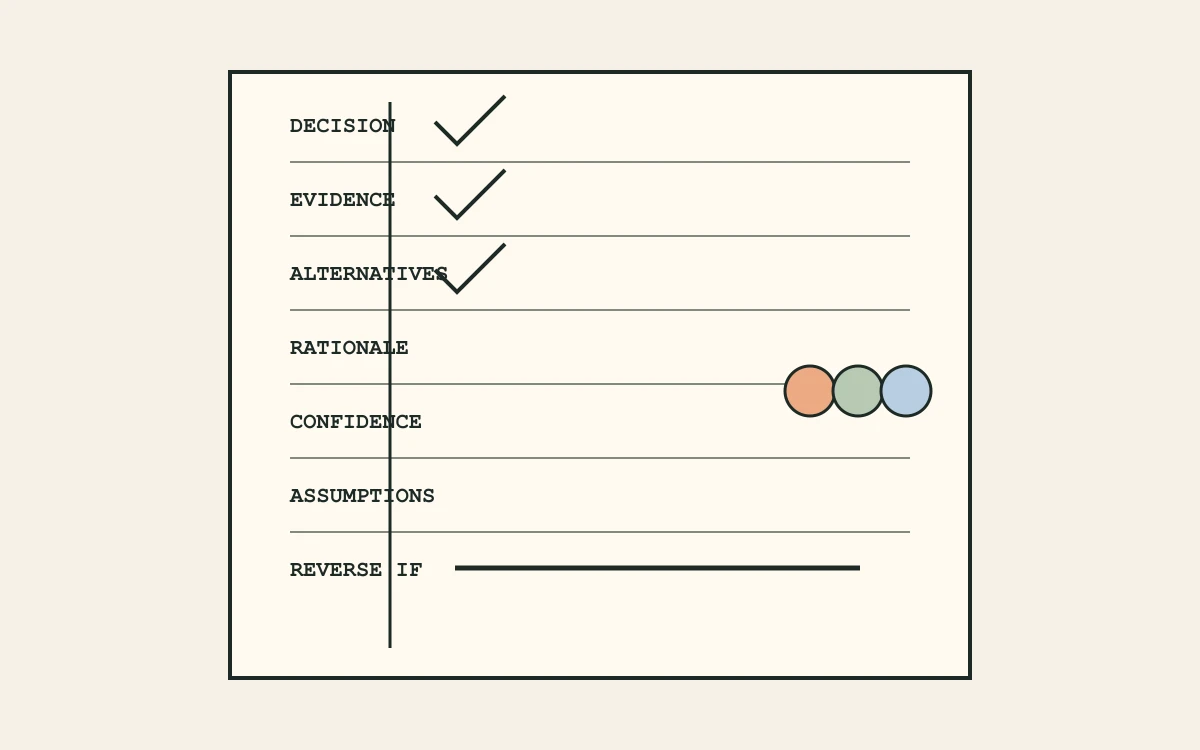
The useful part of an AI-assisted decision is often missing two weeks later: not the answer, but why it survived. A decision log is a small record that stops a fluent output, a remembered conversation, and an approved choice from becoming the same thing.
It does not manufacture certainty. It gives the next reviewer somewhere precise to disagree.
Copy this template
DECISION:
EVIDENCE:
ALTERNATIVES:
RATIONALE:
CONFIDENCE:
ASSUMPTIONS:
WHAT_WOULD_CHANGE_OUR_MIND:
FOLLOW_UP:
Use one log for one consequential choice. If the choice is merely a reversible wording variation, do not create theatre around it. If it changes a claim, a budget, a direction, a source boundary, or who does the next work, write the record while the evidence is still available.
What each field prevents
Decision names the actual commitment, not the discussion topic. Evidence separates supplied facts from a model’s suggestions. Alternatives keeps the rejected option visible. Rationale explains the trade-off. Confidence states how provisional the decision is. Assumptions names what was treated as true without proof. What would change our mind gives a reversal a trigger instead of an apology. Follow-up assigns the next check and its owner.
Worked example: a fictional editorial handoff
This is a transparent hypothetical, not a real-company decision.
DECISION: Use a source-led outline before drafting a client presentation.
EVIDENCE: The source packet contains two conflicting market estimates and three claims without a named source.
ALTERNATIVES: Draft slides first; ask AI to reconcile the estimates; remove the disputed section.
RATIONALE: An outline makes the disagreement visible before design increases the cost of changing it.
CONFIDENCE: Medium.
ASSUMPTIONS: The client can confirm the correct estimate within two working days.
WHAT_WOULD_CHANGE_OUR_MIND: A verified source shows the estimates measure the same population and period.
FOLLOW_UP: Research owner checks the source definitions before slide design begins.
The log does not prove that the outline is better. It records why that choice was responsible under the stated conditions.
Keep it attached to the work
Put the log beside the brief, source ledger, or project handoff—not in a private chat. Link evidence to the exact source where feasible. Mark AI-generated alternatives as proposals, not evidence. When the follow-up changes the assumptions, append a new entry rather than rewriting the old one into apparent certainty.
For claim-level inspection, use the source-led review. The log answers a different question: given the evidence and uncertainty we had, what did we choose to do?
Practical resources
Evidence ledger
Sources
Links are descriptive and separated from editorial conclusions. Product behavior may change after the review date.
Next methods
Continue the work
guide · methods
The Source-Led Review: How to Check an AI Draft Before It Leaves Your Team
A calm, repeatable review pass for finding unsupported claims, hidden assumptions, and overconfident language in AI-assisted drafts.
workflow · methods
A Reliable AI Workflow for Turning Messy Research into a Clear Brief
A traceable evidence-to-decision pipeline with explicit contradiction and uncertainty passes.