
A Reliable AI Workflow for Turning Messy Research into a Clear Brief
A traceable evidence-to-decision pipeline with explicit contradiction and uncertainty passes.
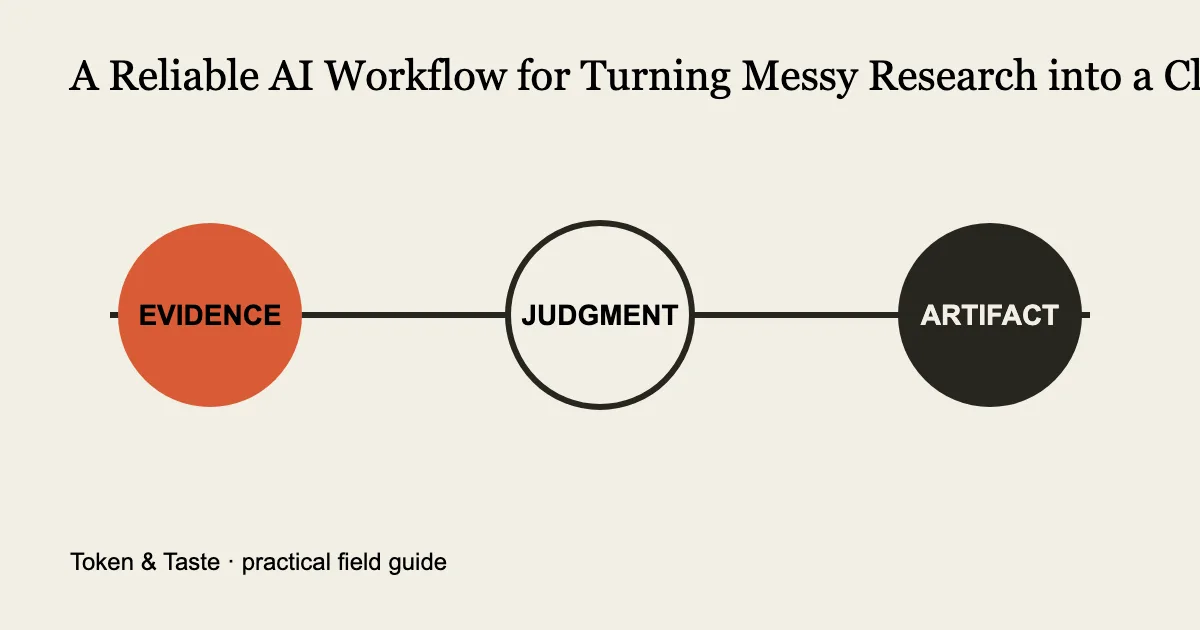
Messy research does not become decision-ready when it is merely summarized. Notes contain duplicates, half-formed interpretations, missing context, and disagreements. A useful brief preserves those conditions long enough to make a defensible choice.
This workflow turns a bounded packet into a traceable brief. AI may assist with normalization and comparison; the accountable editor owns categorization, prioritization, and the final recommendation.
Begin with the messy state
Freeze a working copy and assign every source and note an ID. Preserve the original wording beside any cleaned version. Record author, date, context, and permission level. Remove or redact personal and confidential information before using an external service.
Do not start by asking for themes. First distinguish:
- direct observation or quotation;
- reported fact that needs verification;
- participant or author interpretation;
- project constraint;
- open question.
Normalize without flattening
Standardize dates, names, and obvious formatting, but retain qualifiers such as “sometimes,” “in this market,” or “for new customers.” Keep duplicates linked rather than deleting them: repetition from one source is not independent support.
A model can propose normalized rows, but compare each row with the original. Reject invented subjects, expanded acronyms, and paraphrases that strengthen certainty.
Categorize provisionally
Cluster notes using descriptive labels, then test each cluster:
- What belongs here?
- What almost belongs but does not?
- Which source types dominate?
- What evidence contradicts the label?
- Would a different label change the decision?
Move from broad themes to tensions—two forces the decision must reconcile. “Speed” is a topic. “Faster intake reduces the context reviewers need” is a tension.
Extract evidence before synthesis
Create a claim ledger with claim ID, supporting note IDs, counterevidence, confidence language, owner, and verification status. A claim with no source ID stays an editorial hypothesis. A source URL without a located passage is not verified.
Prioritize for the decision
Rank candidate findings by relevance to the stated decision, strength and diversity of support, consequence if wrong, and ability to act. Do not use an unexplained total score. A low-frequency observation may still matter when its consequence is serious; say why it was elevated.
Assemble the brief
A decision-ready brief contains:
- decision and audience;
- scope and source boundaries;
- supported findings with claim IDs;
- tensions and alternative interpretations;
- recommendation and options rejected;
- risks, unknowns, and reversal conditions;
- next actions, owners, and linked evidence ledger.
Illustrative transformation
Messy input: Nine fictional project notes mix delivery complaints, feature requests, and guesses about customer motivation. Three notes repeat the same account manager’s interpretation.
Process: The editor separates observation from interpretation, links the repeated notes to one origin, and finds a contradiction: customers value speed during setup but request more explanation before approval.
Useful brief: Instead of “Customers want a faster process,” it states: “In this limited packet, setup delay and approval uncertainty appear at different stages. Test a shorter intake plus a clearer approval checkpoint.” It records the missing evidence and does not call nine synthetic notes a market sample.
Try, check, and save
Try: Normalize ten low-risk notes into the five evidence types above. Stop before synthesis and inspect what was lost.
Check: Can every consequential statement return to an original note? Are dissent and source concentration visible? Does the recommendation follow from the evidence rather than merely sound plausible?
Save: Download the strategic brief template and attach the claim ledger rather than burying it in chat history.
Limits
This method improves traceability, not representativeness. It cannot correct a biased sample, obtain missing consent, or replace subject expertise. Model output must be reviewed against the originals. When the evidence is insufficient, the correct brief may recommend more research rather than a decision.
A clear brief is not a clean-looking summary. It is a compact decision record that shows its evidence, judgment, and uncertainty.
Practical resources
Evidence ledger
Sources
Links are descriptive and separated from editorial conclusions. Product behavior may change after the review date.
Next methods
Continue the work
guide · tools
How to Use Claude for Brand Research
A staged evidence-led workflow for researching a brand with Claude while keeping claims traceable.
comparison · tools
ChatGPT vs Claude for Strategic and Creative Work
A task-based selection framework that avoids declaring a universal model winner.