
How to Use Claude for Brand Research
A staged evidence-led workflow for researching a brand with Claude while keeping claims traceable.
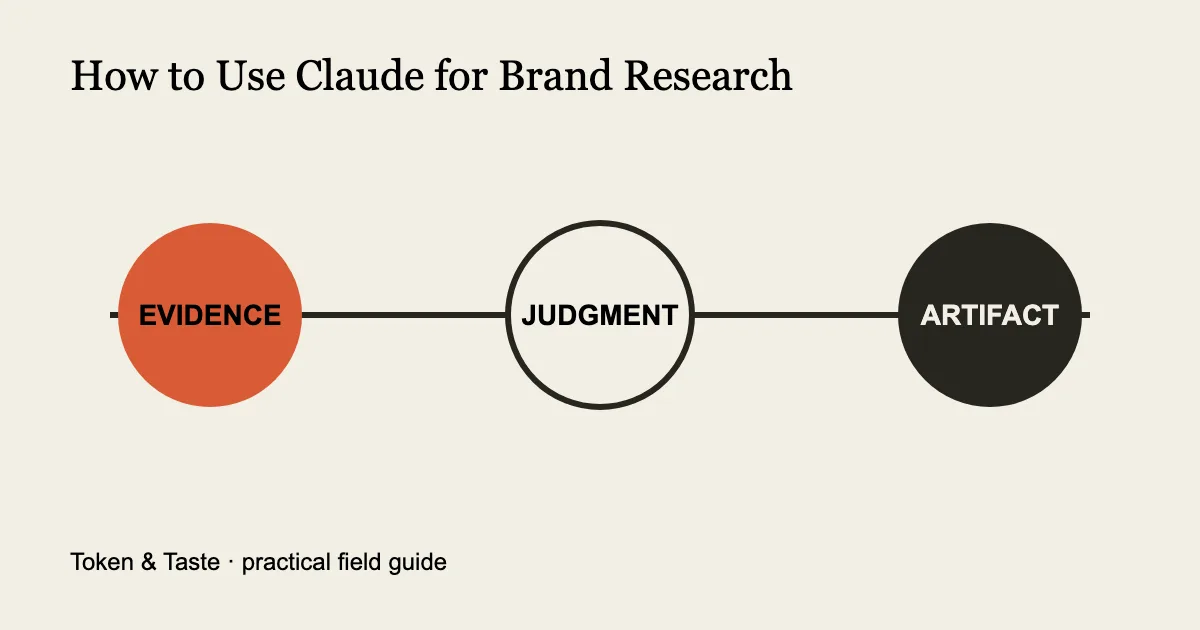
A brand-research brief becomes unreliable when company claims, customer accounts, and editorial interpretation are blended into one smooth narrative. This workflow uses Claude to organize a bounded source set while keeping the researcher—not the model—responsible for verification and judgment.
This is an editorial method, not a report of a model benchmark. The example below is explicitly illustrative. Product behavior varies by model, account, interface, and date.
Define the question before collecting material
Write one decision the research must support: “Which position could this organization credibly own?” is useful; “Tell me about this brand” is not. Add audience, geography, time period, and exclusions. These boundaries reveal when a source set cannot answer the question.
Build a source ledger
Collect deliberately rather than pasting the first search results into a chat. Give every item an ID and classify it:
- Company claim: website, annual report, product page, or executive statement.
- Customer evidence: reviews, interviews, support themes, or research the team is allowed to use.
- Independent evidence: reporting, public records, or relevant research.
- Competitor material: comparable claims and proof from the category.
Record publisher, date, URL or file location, and the exact passage that matters. A company repeating its own claim across five pages is still one interested source, not five independent confirmations.
Use Claude in four bounded passes
1. Inventory without interpretation
Ask for a table of source ID, explicit claim, quoted or closely paraphrased support, date, and missing context. Tell Claude to write “not in the supplied sources” rather than fill gaps.
2. Separate claim from corroboration
Ask which ideas recur, then distinguish repetition by the same publisher from independent support. Review every row against the original source before continuing.
3. Challenge the emerging account
Request contradictory evidence, alternative explanations, and groups or periods absent from the corpus. This is where a tidy story should become less tidy—and more honest.
4. Draft the brief
Only now ask for a brief containing the research question, source boundaries, supported observations, tensions, implications, open questions, and source IDs beside consequential claims.
Prompt to adapt
Using only the numbered sources below, create an inventory before offering a synthesis. For each claim, cite the source ID and distinguish company claim, customer evidence, independent evidence, and your interpretation. Mark missing support as “not established.” Then list contradictions and coverage gaps. Do not infer market perception from company copy.
The prompt works because it defines material, labels evidence types, constrains uncertainty, and specifies an inspectable output. It cannot make a weak source set strong.
Illustrative example: Northstar Studio
Imagine a fictional studio whose website says its process is “highly collaborative.” Two supplied client notes praise frequent working sessions; a third says decisions were unclear. A generic summary would label collaboration a strength. The ledger supports a narrower conclusion: frequent contact is visible in the supplied material, but decision ownership is disputed. The brief should preserve both observations and recommend further research rather than convert three notes into a market claim.
Try, check, and save
Try: Choose six varied sources about one organization, assign IDs, and run only the inventory pass.
Check: Open every cited source. Can you locate support for the whole sentence? Are company claims visibly separate from independent or customer evidence? Are absences named?
Save: Export the source ledger and brief together. The related brand research skill provides a reusable structure.
Limits and responsible use
Do not upload confidential, personal, licensed, or client material without authority and an appropriate data-handling review. Claude can organize supplied text; it does not verify a URL merely by citing it. Vendor documentation describes intended product behavior, not independent evidence of output quality. Record the visible model or interface and test date when those details matter.
A trustworthy brand brief is not the most fluent account. It is the one another editor can challenge, trace, and update.
Practical resources
Evidence ledger
Sources
Links are descriptive and separated from editorial conclusions. Product behavior may change after the review date.
Next methods
Continue the work
comparison · tools
ChatGPT vs Claude for Strategic and Creative Work
A task-based selection framework that avoids declaring a universal model winner.
guide · methods
How to Build a Presentation with AI Without Losing the Argument
An argument-first sequence that separates evidence, narrative, and slide production.